
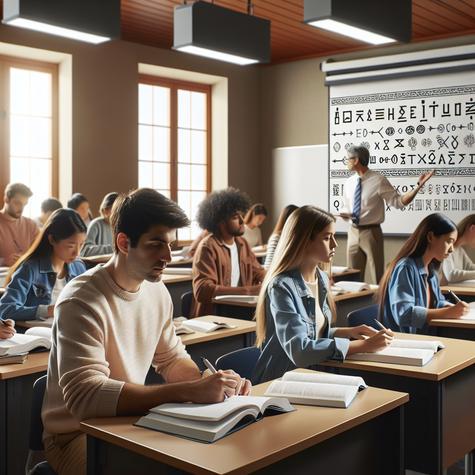
 A classical education refers to a methodology of learning that has its roots in ancient Greece and Rome. It involves a three-part process to train the mind:
1. The Grammar Stage: This involves accumulating knowledge and facts. Children learn the rules of phonics, spelling, and grammar; they study cultures, geography, and historical facts; learn about the elements of nature; and math principles.
2. The Logic Stage: Children are encouraged to apply logic and reasoning to the knowledge they have accumulated. They are taught formal logic and how to argue their cases convincingly and effectively.
3. The Rhetoric Stage: At this stage, students are taught how to articulate in writing and speech, their thoughts and ideas clearly and persuasively.
A classical education, therefore, involves a robust understanding and appreciation of the great works of Western literature and thought, developing a strong foundation in languages, history, philosophy, and other humanities disciplines.
At universities such as Brown, a Classics student could study the ancient Greek language for all four years. This begins with learning the basics of the ancient Greek language, progressing to the reading and interpretation of Greek classical texts, and can also include courses in Greek history, literature, and philosophy. Other top-tier universities recognized for their classics programs include Princeton, Stanford, and Harvard.
As a high school student, you can prepare for a classical education in several ways. Given the language-heavy nature of most Classics programs, gaining a strong foundation in English, Latin, or even Ancient Greek can be beneficial. Courses in world history and literature can also add value, as they often explore many of the civilizations and works that you would examine more deeply in a Classics program.
Study hard, take rigorous courses, particularly in history and language, volunteer or intern at museums, join a debate team, and enter essay contests to refine your writing and argumentation skills. Also, read widely, particularly classical works of literature, philosophy, and other influential texts from throughout Western history.
Remember that gaining a classical education is not just about preparing for a career, but about developing a mindset of intellectual curiosity, critical thinking, and a lifelong love of learning.